
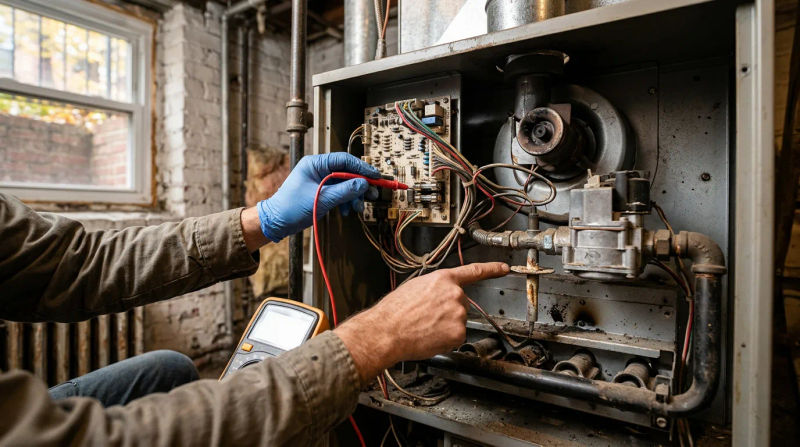
As a service technician with over 15 years of experience in New York, I see the same story play out every October. The air gets that distinct autumn crispness, leaves start to pile up on the sidewalks, and the first real cold night sends a shiver through the city. You walk over to your thermostat, switch it to ‘Heat’ for the first time since spring, and wait for that familiar, comforting rush of warm air. But instead, you get silence. Your furnace, which sat dormant all summer, has decided not to wake up. When your furnace won’t start New York nights can feel especially long and cold, but don't panic. Often, the issue is something simple you can identify yourself.
After a long summer of inactivity, it’s common for heating systems to reveal underlying issues when they’re first called into service. From our work in buildings across the city, we know that small problems - a tripped breaker in a shared electrical panel or a safety feature engaging - are frequently the culprit when a New York furnace not turning on after summer becomes a reality. Let’s walk through what you might be experiencing and what could be causing it.
Common Signs and Symptoms
When a furnace fails to start, it can manifest in a few different ways. Understanding what to look and listen for is the first step in diagnosing the problem. Our technicians are trained to recognize these subtle cues, and you can too.
- Complete Silence: You adjust the thermostat, but absolutely nothing happens. There are no clicks, no hums, no sounds from the furnace unit at all.
- Clicking, But No Ignition: You can hear a clicking sound coming from the furnace, which is often the ignitor trying to light the gas, but the main burners never fire up. After a few tries, the clicking stops.
- The System Starts, Then Immediately Stops: The furnace might kick on, run for a few seconds, and then abruptly shut down. This cycle might repeat a few times before the system gives up entirely. This is one of the classic furnace ignition lockout symptoms New York homeowners encounter.
- The Blower Runs, But The Air is Cold: The fan is working and air is coming through your vents, but it’s cool or room temperature, not heated. This indicates the blower motor has power, but the heating component of the system is failing.
What Causes This Problem
Based on thousands of service calls, we’ve found that the reasons a furnace won't start usually fall into a few common categories. Here are the most frequent causes we encounter, from simple fixes to more complex mechanical issues.
- Thermostat and Power Issues
Before assuming the worst, always start with the controls. It's surprising how often the problem is a simple oversight. If your thermostat set to heat but furnace won’t start NYC, check for dead batteries in the thermostat itself. Also, ensure it's set to 'Heat' and the temperature is set at least five degrees above the current room temperature to trigger the system. Next, check your electrical panel. In many of New York's beautiful pre-1940s brownstones and multi-unit buildings, shared or older electrical panels can be prone to tripping. Locate the breaker for your furnace (it should be labeled) and see if it's been tripped. If it is, reset it once. If it trips again, do not reset it again - this indicates a more serious electrical problem.
- Clogged Air Filter
A severely clogged air filter is one of the most common reasons a furnace won't turn on properly. Your furnace needs adequate airflow to operate safely. If the filter is choked with dust and debris accumulated over the summer, the system can overheat and shut itself down as a safety precaution. This is especially true in the fall when windows have been open. We recommend checking your filter and replacing it if it’s dirty. It's a simple, inexpensive step that can solve a major headache.
- Ignition System Failure
Modern furnaces use an electronic ignitor, while older systems may have a standing pilot light. If the pilot light has gone out, your furnace won't get the flame it needs to ignite the burners. If you have an electronic ignition system, the ignitor can crack or fail over time. The clicking sound you hear without ignition is a tell-tale sign of an ignition problem. This is a primary cause of furnace ignition lockout symptoms New York residents experience, where the system's control board detects a failure to light and shuts the gas valve for safety.
- Blocked Flue or Exhaust Vent
Your furnace creates exhaust gases that must be vented safely outside. In October, heavy leaf fall can easily clog these exterior vents, especially for ground-level or basement units. Modern high-efficiency furnaces have sensors that detect a blockage and will shut the system down to prevent dangerous carbon monoxide from backing up into your home. It’s a critical safety feature that can be mistaken for a furnace malfunction.
- Gas Supply Issues
It may sound obvious, but the gas valve to your furnace must be open. This valve, which has an on/off handle, is typically located on the gas pipe leading to the unit. Sometimes it gets turned off during summer maintenance or for other reasons and is simply forgotten. Ensure the handle is parallel to the pipe, indicating it's open.
When to Call a Professional
While you can safely perform some basic checks yourself, it's crucial to know when to stop and call for expert help. Homeowner troubleshooting should be limited to the following:
- Checking and changing the thermostat batteries and settings.
- Inspecting and replacing a dirty air filter.
- Checking your circuit breaker (resetting it only once).
- Ensuring exterior vents are clear of leaves, snow, or other obstructions.
If you've tried these steps and your furnace won’t start New York, it's time to contact an experienced professional. Do not attempt to diagnose or repair issues related to the gas valve, ignitor, flame sensor, or internal electrical components. These systems are complex and carry significant safety risks, including gas leaks and electrical shock, if handled improperly. Our technicians use specialized diagnostic tools and follow standardized procedures to safely identify the root cause, whether it's a faulty control board, a failing motor, or a sensor malfunction.
Many of the iconic pre-1940s rowhouses in New York have heating systems that have been retrofitted or are housed in tight mechanical spaces, adding a layer of complexity. Experienced professionals are accustomed to these unique environments and can navigate them safely and efficiently.
Conclusion
Facing the first cold October night with a furnace that won't turn on is a stressful experience. However, by running through a few simple checks - thermostat settings, the air filter, and the circuit breaker - you can often rule out or even solve the most common issues. Remember that a furnace that starts and then quickly shuts down is often indicating a safety lockout, pointing to a more specific problem like an ignition failure or a blocked vent.
Don't wait for the problem to get worse or for the temperatures to drop further. Addressing heating issues early in the season is always the best approach. It ensures you have time to get a proper diagnosis and repair without the stress of a no-heat emergency in the dead of winter.
If you notice any of these signs and the basic checks don't resolve the issue, contact a local HVAC professional for an inspection.