
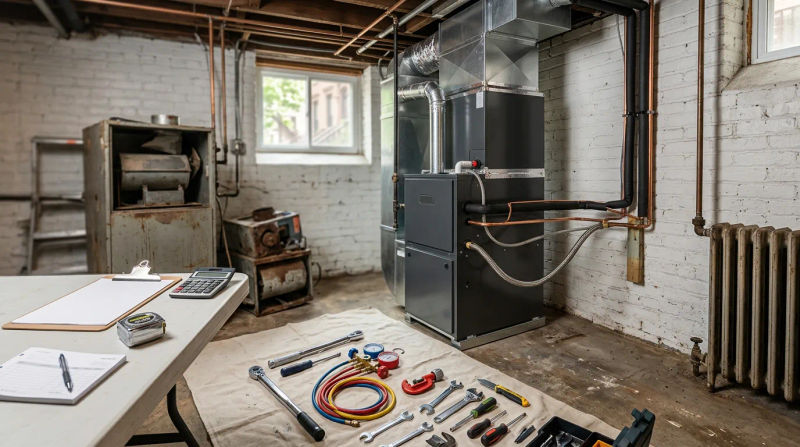
As a technician with over 15 years in the field, I know that when a heating or cooling system fails, the first question on every homeowner's mind is: "How much is this going to cost?" It's a valid and important question. An HVAC system is a major home investment, and you deserve a clear, honest answer. With cooling temperatures signaling the end of summer, now is the perfect time to plan and budget for a replacement before the winter rush begins.
My goal here is to give you a transparent look at the real HVAC replacement cost in Brooklyn. We'll break down the numbers, explore the factors that influence the final price, and give you the right questions to ask so you can make a confident decision for your home.
Average Costs in Brooklyn
Brooklyn's unique housing stock - from historic brownstones to modern multi-family buildings - means there's no single price tag for a new system. However, based on our experience, we can provide some realistic ballpark figures to help you budget. Keep in mind, these are starting points for a quality, professional installation.
- Furnace-Only Replacement: For a standard gas furnace replacement, homeowners in Brooklyn typically invest between $5,500 and $9,500. This includes the unit, labor, and basic materials.
- Central AC-Only Replacement: The central air replacement cost Brooklyn NY homeowners see usually falls between $7,000 and $12,000. This covers the outdoor condenser, the indoor evaporator coil, and associated labor.
- Full HVAC System Replacement (Furnace & AC): Replacing both components at once is often more cost-effective. A complete HVAC system replacement price Brooklyn residents can expect ranges from $10,000 to $20,000+. This wide range is heavily influenced by the factors we'll discuss next.
These prices reflect standard-efficiency equipment and straightforward installations. A new HVAC installation estimate Brooklyn for high-efficiency systems or complex projects will naturally be higher.
Factors That Affect Price
The final invoice for your HVAC replacement is determined by much more than just the equipment itself. In a place like Brooklyn, the specifics of your home play a huge role. Here’s what our technicians look at when building an estimate.
1. System Size and Efficiency Rating
- Size (BTUs): The system must be correctly sized for your home's square footage, layout, insulation, and window placement. We perform a "Manual J" load calculation to determine this. An undersized system will run constantly and fail to keep you comfortable, while an oversized system will cycle on and off too frequently, wasting energy and causing premature wear.
- Efficiency (SEER2/AFUE): Higher efficiency ratings (like SEER2 for AC and AFUE for furnaces) mean lower monthly energy bills. This equipment costs more upfront but provides significant long-term savings. Federal and local rebates can often help offset the initial investment in high-efficiency models.
2. Type of HVAC System
- Split Systems: The most common setup with an outdoor condenser/compressor and an indoor furnace or air handler.
- Heat Pumps: These all-in-one systems provide both heating and cooling. They are highly efficient but can have a higher initial cost.
- Ductless Mini-Splits: Ideal for homes without existing ductwork or for zoning specific areas. The cost depends on the number of indoor heads (air handlers) connected to a single outdoor unit.
3. Installation Complexity and Home Access This is a major variable in Brooklyn. A job that's simple in a suburban home can be much more complex here.
- Access: Is the equipment in a tight crawlspace, a narrow basement, or on a roof? Getting units and tools up multiple flights of stairs in a brownstone or coordinating a crane for a rooftop installation significantly impacts labor time and cost.
- Location of Units: The distance between the indoor and outdoor units affects the length of refrigerant lines and electrical wiring needed, adding to material costs.
4. Ductwork Modifications Your existing ductwork is the circulatory system for your HVAC. If it's old, improperly sized, or leaking, simply connecting a new, high-efficiency unit to it is a recipe for problems. Our assessment includes:
- Inspection: We check for leaks, poor airflow, and asbestos-containing materials (common in older homes).
- Repairs or Replacement: Sealing leaks or replacing entire sections of ductwork is often necessary to ensure the new system performs as designed. This can be a significant portion of the overall HVAC replacement cost.
5. Electrical, Gas Line, and Code Upgrades Older homes often require updates to meet modern safety and building codes. A new system may require a new electrical circuit, a higher-amperage breaker, or modifications to the gas line. These tasks must be done by licensed professionals and will be included in a comprehensive estimate.
How to Get the Best Value
Getting the best value doesn't mean finding the cheapest price. It means investing in a reliable system that will perform efficiently for years to come. Here’s my advice:
- Think Long-Term: Don't just look at the initial price. Ask for an estimate of annual energy savings for a high-efficiency model. The payback period might be shorter than you think.
- Insist on a Manual J Load Calculation: A contractor who wants to size your new system based on your old one's specs is cutting corners. A proper load calculation is the only way to guarantee correct sizing.
- Get Itemized Quotes: A professional quote should clearly break down the costs for equipment, labor, materials, permits, and any necessary ductwork or electrical modifications. This transparency helps you compare apples to apples.
- Prioritize Installation Quality: The single most important factor in your new system's lifespan and performance is the quality of the installation. A top-of-the-line unit installed poorly will fail. Look for companies that invest in training their technicians and have standardized, organized processes.
Questions to Ask Your Contractor
When you receive a new HVAC installation estimate Brooklyn, you are interviewing that company for a major job. Don't be afraid to ask detailed questions. Here are a few I would ask:
- Are you licensed and fully insured to work in New York City?
- Will you perform a Manual J load calculation before recommending equipment?
- Is the cost of pulling permits included in this quote?
- What are the warranty terms for the equipment and for your labor?
- Who is responsible for registering the equipment warranty?
- How will your team protect my floors, walls, and property during the installation?
- What is your process for removing and disposing of the old equipment and refrigerant?
An experienced, professional contractor will have ready and confident answers to all these questions.
Replacing your HVAC system is a significant decision, but it doesn't have to be a stressful one. By understanding the costs and focusing on quality, you can ensure your home remains a comfortable sanctuary for the next 15 to 20 years. A well-planned installation provides peace of mind, improved comfort, and lower energy bills.
For a personalized, no-obligation estimate in Brooklyn, contact Cool Tech hVAC Corp. for a free consultation. Our team is ready to help you find the right solution for your home and budget.