
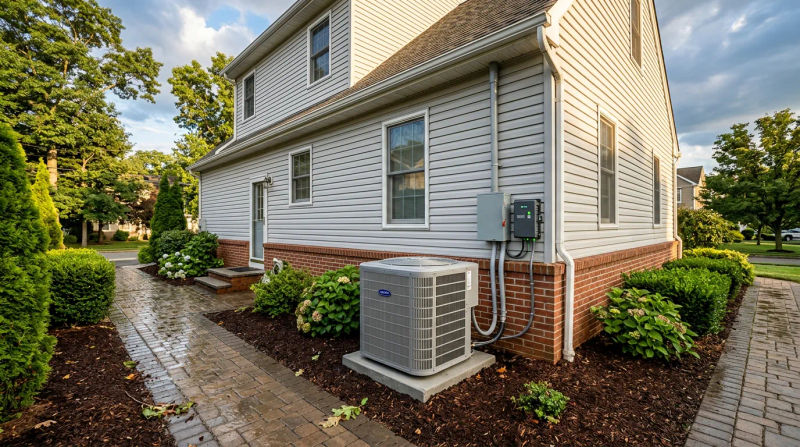
It’s a story we hear all too often here at Cool Tech hVAC Corp., especially during Staten Island’s volatile late-summer storm season. A homeowner in the Sayreville neighborhood was enjoying a relatively cool August evening when a powerful thunderstorm rolled through. The lights flickered, a loud clap of thunder shook the house, and everything seemed fine - until the next afternoon. As the humidity and heat began to build, they realized their central air conditioning was silent. The thermostat was calling for cool, but nothing was happening outside. Their main complaint when they called our office was a classic one for this time of year: their AC condenser won’t turn on after a storm.
As a Senior Technician with over 15 years of experience, I’ve seen this exact scenario play out dozens of times. Electrical grids are vulnerable during storms, and the resulting power surges and brownouts can be lethal for sensitive HVAC electronics. For this family, losing their AC during a sweltering week wasn't just an inconvenience; it was a major disruption to their comfort and peace of mind. They needed a fast, reliable solution, and that’s exactly why they called Cool Tech hVAC Corp. I was dispatched for an emergency service call, ready to diagnose the problem and get their home cool again.
The Assessment
When I arrived at the 1950s-era Ranch home, a common style in that part of Staten Island, the first thing I did was perform a thorough visual inspection. The outdoor condenser unit looked physically fine - no signs of impact from debris. However, the silence was telling. After ensuring the circuit breaker hadn't simply tripped (it hadn't), I opened the unit's service panel.
What I found confirmed my suspicions. The air inside the panel had that distinct, acrid smell of burnt electronics. A quick look at the main control board - the brains of the operation - revealed a blackened spot right near the power input terminals. The board was fried. A secondary test of the dual-run capacitor showed it was also compromised; the top was slightly bulged, a tell-tale sign of internal failure often caused by a sudden jolt of electricity. This wasn't a simple mechanical failure; this was a clear-cut case requiring power-surge AC repair.
I explained to the homeowner that while their system was a quality brand and had been well-maintained, its age and the lack of dedicated surge protection made it highly vulnerable. The home’s mid-century construction meant its electrical infrastructure wasn't originally designed with modern, sensitive electronics in mind. During a storm, power doesn't just go out and come back on cleanly. It can flicker, surge, and drop, sending unstable voltage through the lines. For a delicate circuit board, that’s a death sentence. Our comprehensive post-storm HVAC inspection Staten Island service is designed specifically to identify this type of hidden electrical damage before it leads to a complete system breakdown.
Our Solution
At Cool Tech hVAC Corp., we don't just fix the immediate problem; we provide a complete solution to prevent it from happening again. Our approach was twofold:
- Repair the Immediate Damage: Restore the system to full operational capacity.
- Install Proactive Protection: Safeguard the system against future electrical events.
Fortunately, our service vans are stocked for precisely these situations. I had a universal replacement control board and the correct dual-run capacitor (rated for the unit's specific microfarad and voltage requirements) on hand. The repair process was methodical:
- Safety First: I disconnected all power to the indoor and outdoor units at the breaker panel and the local disconnect box.
- Component Removal: I carefully disconnected the wiring harnesses from the fried control board, labeling each connection to ensure a perfect re-installation. I then removed the faulty board and the damaged capacitor.
- New Component Installation: I installed the new control board, meticulously reconnecting every wire according to the manufacturer's diagram. The new capacitor was then secured in its bracket and wired in.
- System Check: Before closing everything up, I checked all connections for tightness and ensured no wires were pinched or routed improperly.
With the repair complete, we moved to the most critical part of the job: prevention. I recommended an HVAC surge protector installation Staten Island homeowners should consider essential. We use a high-quality, Type 2 surge protective device (SPD) designed specifically for HVAC equipment. This device is installed at the disconnect box right next to the outdoor condenser. It acts like a bodyguard for the air conditioner, constantly monitoring the incoming voltage. If it detects a surge or spike, it instantly diverts the excess electricity to the ground, sacrificing itself if necessary to protect the expensive and sensitive components inside the AC unit.
The installation took less than 30 minutes. We mounted the device, connected it to the line-side of the disconnect, and verified it was operational via its indicator lights. This is a standard part of the service we provide at Cool Tech hVAC Corp. because a simple repair without prevention is only half the job.
The Results
With the new components and surge protector installed, the moment of truth arrived. I restored power at the breaker, switched on the disconnect, and went inside to turn on the AC at the thermostat. Within seconds, we heard the satisfying hum of the indoor blower followed by the powerful whir of the outdoor condenser fan and compressor kicking on. Cold air began flowing from the vents almost immediately.
The difference was night and day. Before our visit, the homeowner had a dead, silent system and the prospect of a hot, uncomfortable week. After our work was complete - all within a single visit - they had:
- A Fully Functional AC System: Their home was cooling down rapidly, restoring comfort and normalcy.
- Enhanced System Reliability: With a new control board and capacitor, the core electrical components were fresh and performing optimally.
- Long-Term Peace of Mind: The newly installed HVAC surge protector meant they no longer had to worry every time a storm was in the forecast. Their investment was now protected from the most common cause of post-storm failure.
The homeowner was incredibly relieved, not only by the speed of the repair but also by the educational approach we took. They now understood why the failure occurred and felt empowered by the preventative solution we installed. This commitment to thoroughness and customer education is a hallmark of the Cool Tech hVAC Corp. experience.
This project perfectly illustrates our philosophy. We don't just put a band-aid on the problem; we diagnose the root cause and provide a durable, forward-thinking solution that delivers real value and lasting peace of mind for our clients.
Ready for your own Cool Tech hVAC Corp. experience? Contact us today for a free inspection.